Address
824-825, St.no 2, Murad Pura Rd, Miller Ganj, Ludhiana, Punjab 141001

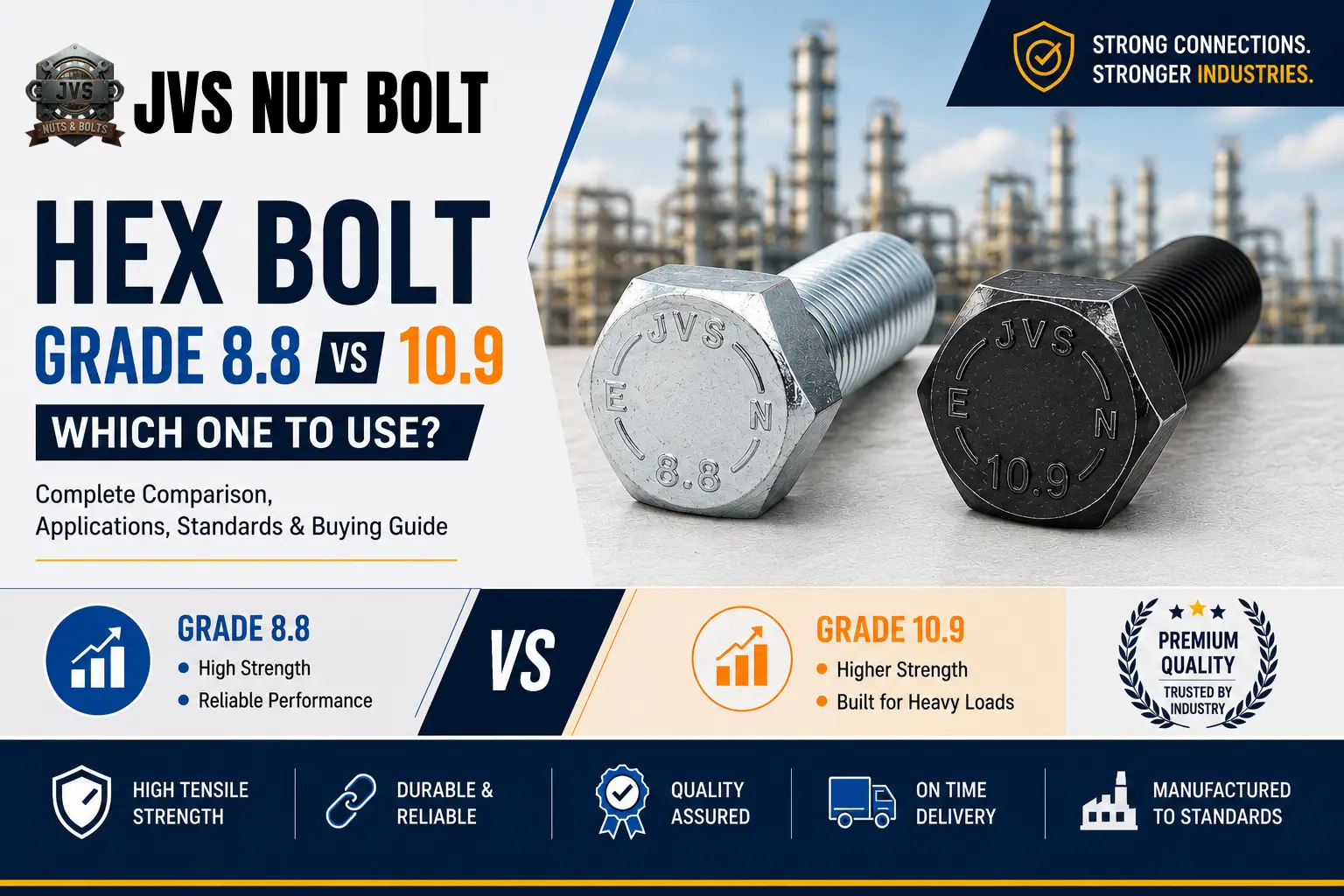
If you’ve ever ordered hex bolts for an industrial project, you’ve probably come across markings like 8.8 and 10.9 stamped on the bolt head. Most people either ignore them or just go with whatever the hardware shop has in stock. But these numbers are not just codes — they tell you exactly how strong the bolt is, what load it can handle, and whether it’s the right fit for your application.
Getting the grade wrong can mean loose joints, fatigue failures, or in serious cases, a structural collapse. On the other hand, over-engineering by using 12.9 bolts everywhere will unnecessarily increase your project cost.
In this guide, we’ll break down the difference between Grade 8.8 and 10.9 hex bolts in plain language — no confusing metallurgical jargon — so you can make the right choice for your project.
Understanding Hex Bolt Grade 8.8 vs 10.9 Ratings
The two numbers in a bolt grade (like 8.8) follow a specific system defined by ISO 898-1, which is the international standard for mechanical fastener properties.
- The first number (e.g. 8 in 8.8) represents 1/100th of the nominal tensile strength in MPa. So 8 means 800 MPa tensile strength.
- The second number (e.g. .8 in 8.8) represents 10 times the ratio of yield strength to tensile strength. So .8 means the yield strength is 80% of the tensile strength.
In simple terms: the higher the numbers, the stronger the bolt. But strength is not the only thing that matters — ductility, brittleness, and application conditions all play a role in which grade you should choose.
Grade 8.8 Hex Bolts – The Everyday Workhorse
What is Grade 8.8?
Grade 8.8 is the most commonly used hex bolt grade in industrial and construction applications across India and globally. It’s often called the “standard high-tensile bolt” in the market, though it’s technically considered a medium-high strength fastener.
Tensile Strength: 800 MPa
Yield Strength: 640 MPa (80% of tensile)
Material: Medium carbon steel, quenched and tempered
Head Marking: 8.8 stamped on the bolt head
Where is Grade 8.8 Used?
- General structural steelwork and building frames
- Civil construction – RCC frameworks, column clamps, beams
- Agricultural machinery and farm equipment
- Fabrication workshops and light industrial machinery
- Electrical panels, enclosures, and switchgear assemblies
- Water treatment and plumbing pipelines
Pros of Grade 8.8
- Most economical high-tensile bolt available
- Widely available across India in all sizes
- Easy to work with – good ductility, low brittleness risk
- Suitable for most standard industrial applications.
Limitations
- Not ideal for high-vibration environments without additional locking
- Cannot be used in applications demanding very high clamping force
- May require more bolts to distribute load compared to higher grades
Grade 10.9 Hex Bolts – The Automotive & Machinery Standard
What is Grade 10.9?
Grade 10.9 is a step up in strength and is widely used in the automotive industry, heavy machinery, and anywhere that demands higher clamping force in a smaller package. These bolts are manufactured from medium carbon alloy steel and go through a rigorous quenching and tempering process.
Tensile Strength: 1000 MPa
Yield Strength: 900 MPa (90% of tensile)
Material: Alloy steel – quenched and tempered
Head Marking: 10.9 stamped on bolt head
Where is Grade 10.9 Used?
- Automotive engines, gearboxes, and chassis assemblies
- Railway track fastening and rail infrastructure
- Heavy engineering and press tools
- Flanged pipe joints under pressure
- Wind turbine and solar mounting structures (high-load points)
- Conveyor systems and material handling equipment
- Bridge construction and infrastructure projects
Pros of Grade 10.9
- 25% higher strength than 8.8 – fewer bolts needed for same load
- Good balance of strength and ductility
- Widely specified in IS, DIN, and ASTM standards for critical joints
- Suitable for vibration-prone applications with proper locking
Limitations
- More expensive than Grade 8.8
- Slightly more brittle – care needed during installation to avoid over-torquing
- Should not be welded in most applications
Grade 8.8 vs 10.9 – Full Comparison Table
To make the hex bolt grade 8.8 vs 10.9 selection process easier, let’s compare their key mechanical properties side by side.
| Property | Grade 8.8 | Grade 10.9 |
|---|---|---|
| Tensile Strength | 800 MPa | 1000 MPa |
| Yield Strength | 640 MPa | 900 MPa |
| Hardness (HRC) | 22–32 | 32–39 |
| Material | Medium Carbon Steel | Alloy Steel (Quenched & Tempered) |
| Head Marking | 8.8 | 10.9 |
| Common Finish | Plain, Zinc Plated | Zinc Plated, Black Oxide |
| Typical Use | General Industrial Applications | Automotive, Heavy Machinery & Structural Applications |
| Cost Level | Low | Medium |
| Brittleness Risk | Low | Medium |
How to Identify the Grade of a Bolt – The Head Marking System
If you’re still unsure about hex bolt grade 8.8 vs 10.9, the industry-wise recommendations below can help you choose the right fastener.
| Industry / Application | Recommended Grade | Why? |
|---|---|---|
| General construction | 8.8 | Cost-effective, sufficient load capacity |
| Structural steel frames | 8.8 or 10.9 | Depends on design load requirements |
| Automotive engines | 10.9 | Handles vibration and thermal expansion |
| Railway track fastening | 10.9 | High dynamic loads, IS specification |
| Heavy machinery assembly | 10.9 | Precision torque + high clamping force |
| Solar panel structures | 8.8 | Corrosion resistance matters most |
| Flange joints (pressure) | 10.9 | Consistent bolt load, no relaxation |
| Conveyor systems | 10.9 | Vibration resistance, tight tolerances |
| Foundation bolts | 8.8 or custom | Embedded, tensile pull-out critical |
How to Identify the Grade of a Bolt – The Head Marking System
Every properly manufactured hex bolt has its grade stamped on the head. Here’s what to look for:
- Grade 8.8 → Two dots or the number “8.8” on the hex head
- Grade 10.9 → The number “10.9” stamped clearly
If a bolt has no marking at all, it’s likely a low-grade or ungraded fastener — avoid using these in any structural or load-bearing application. Always insist on grade-marked bolts from a certified manufacturer.
Common Mistakes to Avoid When Choosing Bolt Grades
1. Using Grade 12.9 everywhere “just to be safe”
This is one of the most common mistakes in procurement. Higher grade does not always mean better. Grade 12.9 bolts are harder and more brittle. In applications where joints flex slightly (like in construction structures or general fabrication), this brittleness can actually cause failures that a more ductile Grade 8.8 bolt would have survived.
2. Mixing grades in the same joint
Never mix bolt grades within a single bolted joint — for example, using some 8.8 and some 10.9 in the same flange connection. This creates unequal load distribution and can lead to progressive failure.
3. Ignoring surface finish requirements
Grade alone isn’t enough. If your application involves outdoor exposure, moisture, or chemicals — you also need to specify the coating. A Grade 10.9 bolt with plain finish will corrode outdoors. Ask your supplier about zinc plating, hot-dip galvanising, or stainless steel options depending on your environment.
4. Over-torquing high-grade bolts
Both Grade 8.8 and Grade 10.9 hex bolts have recommended torque values that should be followed during installation. Applying excessive torque can damage threads, reduce clamping efficiency, or even lead to bolt failure under load. Grade 10.9 bolts, due to their higher strength, require more precise torque control to ensure optimal performance. Always use a calibrated torque wrench and refer to the manufacturer’s torque chart based on the bolt size and grade to achieve a secure and reliable joint.
A Note on Coating and Corrosion Protection
When ordering hex bolts, the grade tells you about mechanical strength — but the coating tells you about corrosion resistance. Here’s a quick guide:
- Plain finish (no coating) – For indoor or dry applications only
- Zinc plated (electro-galvanised) – Light outdoor protection; standard for most industrial use
- Hot-dip galvanised (HDG) – Best for outdoor structural applications (bridges, towers, solar)
- Black oxide / phosphate – Common on 8.8 and 10.9 offers minimal corrosion protection but good anti-galling
Always specify both the grade and the finish when placing a bulk fastener order. This avoids costly rework or replacements down the line.
Frequently Asked Questions
Q1. What is the difference between Grade 8.8 and Grade 10.9 hex bolts?
Industrial fasteners are hardware components used to join or secure different parts together in machinery, construction, automotive, and engineering applications. Common fasteners include nuts, bolts and washers.
Q2. Can I replace a Grade 10.9 bolt with a Grade 8.8 bolt?
The most commonly used industrial bolts include:
- Hex Bolts
- High Tensile Bolts
- Allen Bolts
- Foundation Bolts
- Flange Bolts
Q3. How can I identify the grade of a hex bolt?
High tensile bolts offer superior strength, durability, and load-bearing capacity. They are designed to withstand high pressure, vibration, and extreme industrial conditions.
Q4. What is the difference between ISO and IS standards for bolt grades?
JVS Nut Bolt manufactures industrial fasteners including high tensile bolts, nuts, washers, threaded rods, and foundation bolts. The company focuses on industrial fastening solutions for construction, engineering, infrastructure, and machinery sectors.
Q5. Where can I buy Grade 8.8 and Grade 10.9 hex bolts in bulk in India?
JVS Nut Bolt manufactures and supplies high-quality Grade 8.8 and Grade 10.9 hex bolts from its manufacturing facility in Ludhiana, Punjab. We offer bulk supply, customized specifications, and PAN India delivery for industrial, infrastructure, and engineering projects.