Address
824-825, St.no 2, Murad Pura Rd, Miller Ganj, Ludhiana, Punjab 141001

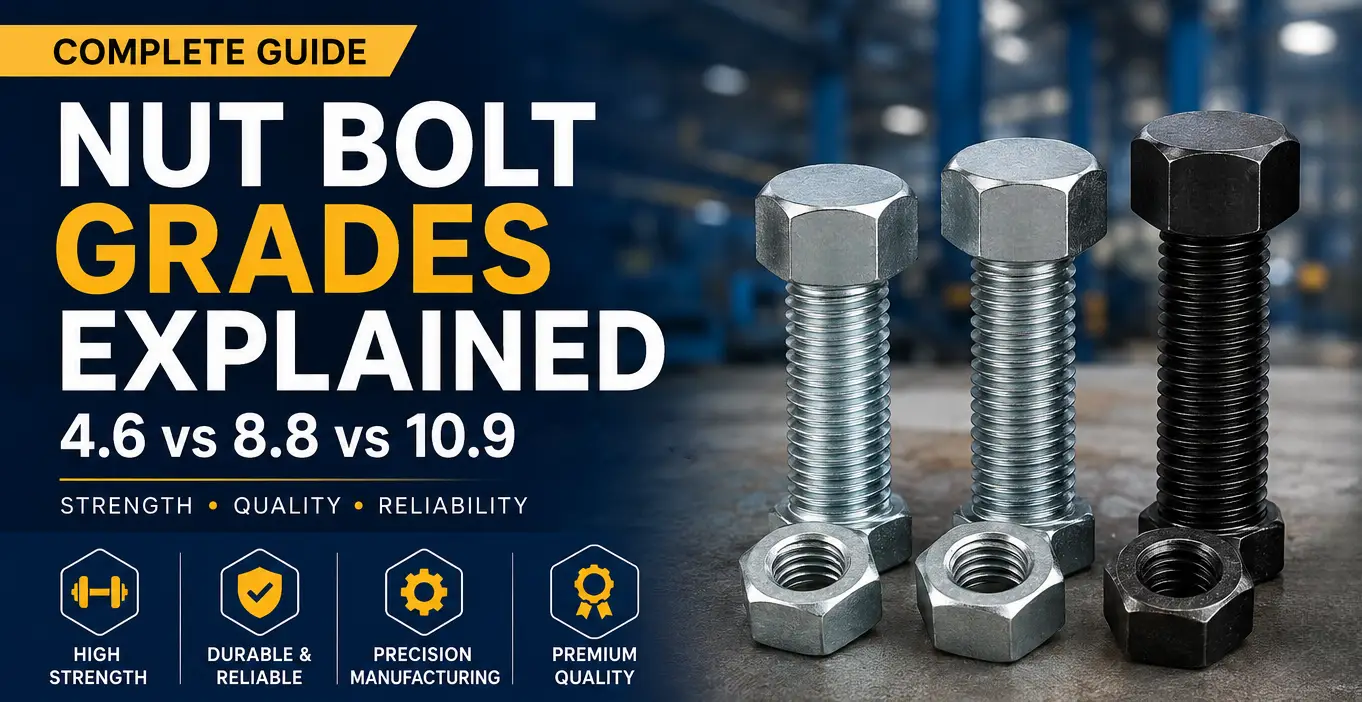
Nut Bolt Grades Explained 4.6 vs 8.8 vs 10.9 Bolts
When selecting industrial fasteners, one of the most important factors to consider is the bolt grade. Engineers, contractors, project managers, and procurement teams often encounter grades such as 4.6, 8.8, 10.9 while purchasing bolts. However, many people are unsure about what these numbers mean and which grade is best suited for their application.
Choosing the wrong bolt grade can lead to equipment failure, structural instability, increased maintenance costs, and safety risks. Understanding bolt grades helps ensure optimal performance, durability, and reliability in industrial projects.
In this comprehensive guide, we explain everything about bolt grades, their properties, applications, advantages, and how to choose the right fastener for your project.
What Are Bolt Grades?
Bolt grades indicate the mechanical properties of a bolt, including tensile strength and yield strength. These grades help determine how much load a bolt can withstand before breaking or deforming. The most commonly used metric bolt grades include:- Grade 4.6
- Grade 8.8
- Grade 10.9
Understanding the Meaning of Bolt Grades
The numbers in a bolt grade represent specific mechanical properties.
For example:
Grade 8.8
The first number (8) represents one hundredth of the nominal tensile strength.
Tensile Strength:
8 × 100 = 800 MPa
The second number (.8) indicates the ratio of yield strength to tensile strength.
Yield Strength:
800 × 0.8 = 640 MPa
This system applies to all metric bolt grades.
Grade 4.6 Bolts
Grade 4.6 bolts are considered low-carbon steel fasteners used in light-duty applications.
Key Features
- Moderate strength
- Economical solution
- Easy availability
- Suitable for general engineering
Applications
- Furniture manufacturing
- Light fabrication
- Agricultural equipment
- Household machinery
- Non-critical assemblies
Advantages
- Cost-effective
- Easy to install
- Suitable for low-load applications
Limitations
- Lower strength
- Not suitable for heavy machinery
- Limited use in structural projects
Grade 8.8 Bolts
Grade 8.8 bolts are among the most widely used high-tensile fasteners in industrial applications.
Key Features
- High tensile strength
- Excellent durability
- Reliable performance
- Suitable for medium and heavy loads
Applications
- Construction projects
- Steel structures
- Industrial machinery
- Automobile industry
- Power plants
- Infrastructure projects
Benefits
- High load-bearing capacity
- Better fatigue resistance
- Long service life
- Cost-effective strength-to-price ratio
Because of their versatility, Grade 8.8 bolts are often considered the industry standard for many engineering projects.
Grade 10.9 Bolts
Grade 10.9 bolts are manufactured using alloy steel and undergo heat treatment to achieve superior mechanical properties.
Key Features
- Very high strength
- Excellent wear resistance
- Improved durability
- Suitable for critical applications
Applications
- Heavy machinery
- Mining equipment
- Automotive assemblies
- Wind energy projects
- Industrial equipment
Advantages
- Handles heavy loads
- Reduced risk of failure
- Excellent mechanical performance
Limitations
- Higher cost than Grade 8.8
- Requires proper torque control
Comparison of Bolt Grades
Grade | Tensile Strength (MPa) | Yield Strength (MPa) | Typical Use |
4.6 | 400 | 240 | Light-duty applications |
8.8 | 800 | 640 | Construction & machinery |
10.9 | 1000 | 900 | Heavy industrial equipment |
Which Bolt Grade Is Best?
The answer depends on your application.
Choose Grade 4.6 If:
- Low loads are involved
- Budget is a priority
- General-purpose fastening is required
Choose Grade 8.8 If:
- Structural strength is required
- Construction projects are involved
- Industrial machinery is used
Choose Grade 10.9 If:
- Heavy-duty equipment is involved
- High stress conditions exist
- Reliability is critical
Importance of Surface Coating
Bolt performance is not only determined by grade but also by surface finish.
Popular finishes include:
- Zinc Plated
- Hot Dip Galvanized
- Nickel Plated
- Auto Black
- Golden Finish
- Green Finish
These coatings improve corrosion resistance and increase service life.
Common Industries Using High-Tensile Bolts
Construction Industry
Used in bridges, commercial buildings, industrial sheds, and infrastructure projects.
Railway Industry
Fasteners play a vital role in track systems and railway structures.
Automotive Industry
Used in engines, suspension systems, chassis assemblies, and manufacturing lines.
Renewable Energy Sector
Wind turbines and solar structures require high-strength fasteners.
Heavy Engineering
Industrial machinery and equipment rely on high-tensile bolts for safety and reliability.
Why Choose JVS Nut Bolt?
JVS Nut Bolt manufactures premium-quality industrial fasteners designed to meet modern engineering requirements.
Our Product Range
- Hex Bolts
- Allen Bolts
- Foundation Bolts
- Full Thread Studs
- Half Thread Studs
- Threaded Rods
- Hex Nuts
- Flange Nuts
- Plain Washers
- Spring Washers
Why Customers Trust Us
- Advanced Manufacturing Facility
- High-Quality Raw Materials
- Precision Engineering
- Custom Manufacturing
- Competitive Pricing
- PAN India Supply
- Bulk Order Capability
- Strict Quality Testing
Understanding bolt grades is essential for selecting the right fastener for industrial applications. Grade 4.6, 8.8, and 10.9 bolts each offer unique strength characteristics suited for different engineering requirements. For most construction and industrial projects, Grade 8.8 remains the preferred choice due to its balance of strength, durability, and affordability. However, heavy-duty and critical applications often require Grade 10.9 fasteners. By partnering with a trusted manufacturer like JVS Nut Bolt, businesses can ensure reliable fastening solutions that deliver long-term performance, safety, and value.